

Modulus of elasticity: How stiff is the material?
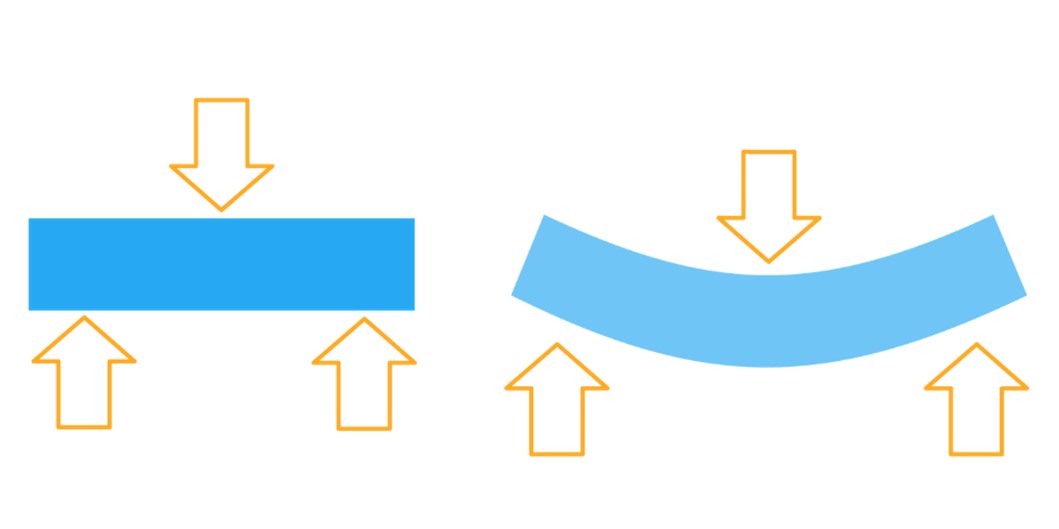
The modulus of elasticity (Young's modulus of elasticity) is a measure of material stiffness and is defined as the material's resistance to elastic deformation.
The bending modulus (eng. flexural modulus , bending modulus ) is equal to the modulus of elasticity for isotropic materials, such as glass, metal and polymers. Compared to soft materials, to deform very rigid materials, it is necessary to apply a force of greater intensity. A high bending modulus value indicates a stiffer material, such as a diamond, while a low bending modulus indicates an elastic material, such as a rubber band.
The modulus of elasticity E (Young's modulus) can be defined as the ratio of the normal stress in the cross-section of the test tube and the corresponding elongation (shortening) in the area of proportionality.
Elongation: Will the material bend and stretch?
Elongation defines how much a material can be stretched without breaking or cracking.
Hard materials, such as brittle-hard plastics, usually form a small elongation at break, while some soft, elastic materials can stretch to several times their own length before breaking.
Elongation is defined as the difference between the length of the tube after fracture and the original (unstressed) length of the tube, divided by the original (unstressed) length of the tube.
Ductile materials, for example - most tires, have a large elongation, while brittle materials such as glass and ceramics tend to elongate very little before breaking, because they do not deform plastically.
Tensile strength: Will the material break under adequate stress?
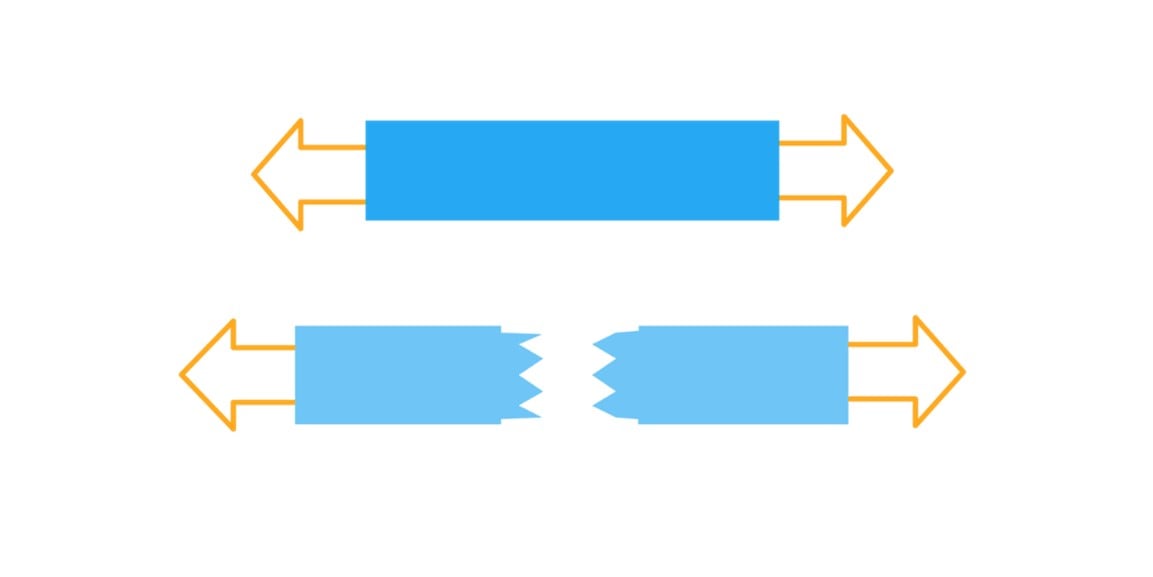
Tensile strength represents the material's resistance to fracture, i.e. the maximum stress with which the material can be subjected to tension without breaking.
A material with high tensile strength is resistant to fracture under tension. Ultimate tensile strength refers to the maximum stress that a material can withstand while being stretched or pulled before breaking. Materials with high tensile strength include carbon, glass and steel.
When this maximum stress is reached, brittle materials break very sharply, without plastic deformation, while ductile materials are characterized by some plastic deformation before fracture.
Today, 3D printing has advanced to be able to provide tensile strength comparable to traditional injection molded plastics such as PP (polypropylene) and ABS.

Yield stress
The yield point or yield stress is a material property defined as the stress at which the material begins to plastically deform, while the yield point is the point where non-linear (elastic + plastic) deformation begins. Before the yield point, the material will deform elastically and will return to its original shape when the applied stress is removed. Once the yield point is exceeded, some part of the deformation will be permanent and irreversible.
Toughness: Can the material absorb impact?
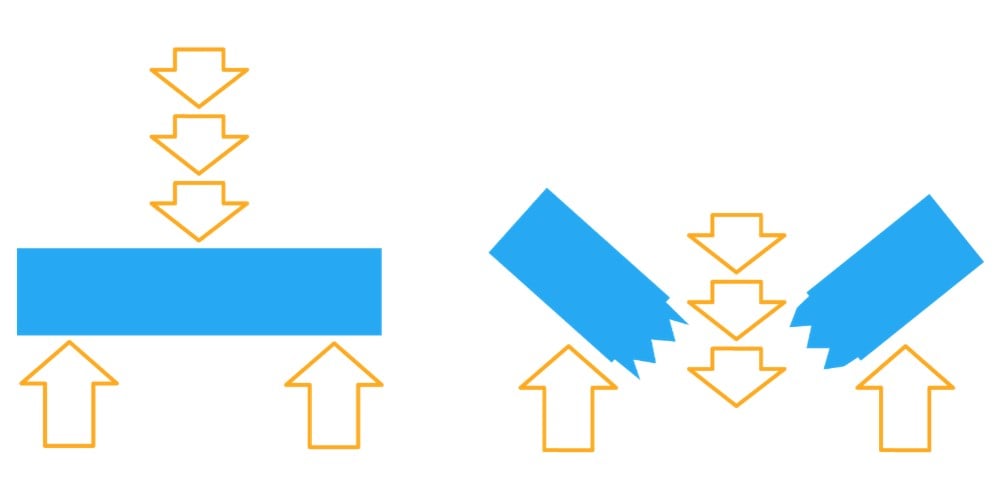
Toughness is the ability of a material to react to sudden impacts, absorb impact energy and plastically deform without breaking, ie the ability of a material to resist impact.
If more work is used to break the sample by dynamic impact, the material is considered tougher. Materials with low toughness are usually hard and brittle. Between toughness and tensile strength there are big differences in mutual relations, so many materials of the same tensile strength have different values of toughness. Materials that have higher values of tensile strength and lower contraction, as a rule, have lower toughness.
In simpler terms - tough materials can be dropped on the floor without breaking. High toughness materials include polycarbonates (PC) and nylons.
In cooperation with the Innovation Center of the Faculty of Mechanical Engineering in Belgrade, an examination of the mechanical properties of test tubes made of different types of materials made by FDM 3D printing technology was carried out. The tests were carried out on a universal machine for testing the mechanical properties of materials.
| Material | Modulus of elasticity [MPa] | Maximum force [N] | Tensile strength [MPa] | Maximum elongation [%] | Yield stress [MPa] | Toughness [J] |
| PLA-X 3D Republic | 3903.46 | 1392.63 | 34.8158 | 9.25934 | 34.0113 | 10.3684 |
| PET-G3D Republic | 2116.13 | 1986.1 | 49.6526 | 17.1503 | 35.4064 | 15.1837 |
| ABS-X3D Republic | 2181.41 | 1650.93 | 41.2733 | 3.76429 | 33.4302 | 4.55841 |
| Novamid® ID1030-CF10 | 3936.99 | 2317.13 | 57.9283 | 7.73973 | 24.7474 | 14.8553 |
| Novamid® ID1070 | 2052.02 | 1664.97 | 41.6242 | 5.24002 | 23.9347 | 7.38364 |
| Carbon 3D Republic | 5983.52 | 2159.38 | 53.9846 | 1.43615 | 45.7304 | 2.15318 |
| PP 3D Republic | 328,762 | 501,312 | 12.5328 | 438,801 | 3.61037 | 180,956 |
Based on the results shown in the table, it can be concluded that the parameter values obtained for polypropylene (PP) differ significantly from the values obtained for other materials - with low values of modulus of elasticity, tensile strength and yield stress and extremely high values of elongation and toughness.