
For our international friends — the English version is just below.
Winter 2015/2016. it wasn't just cold—it was fragile. While the streets of Belgrade were freezing, a decision boiled in me: to step into the unknown — into the world of 3D printing. I was already the father of Lenka and Miloš, and that winter I found out that we were expecting a third child — Marko. Still, nothing could stop me. From the first moment I saw 3D printing, I knew it was more than just technology. It was love. Because 3D printing brings things back from the digital to the analog world — from idea to tangible reality.
At that moment, there were people around me without whom this story would not have existed. One of them was Nenad Duduković - Duduk. A friend who loves me sincerely and without reservation — and I love him. He played the role that every crazy startup has to play: fool friend. One who doesn't ask too many questions, but always believes. The one who gives you money when you're stuck in a dead end — not because he knows you'll succeed, but because he knows you have to try. And that is priceless.
At that time, I also knew David Daković — a man who, through his leadership in business development, helped me understand: I have to start 3D Republic. Because 3D printing is not just a tool — it is a new way of production, the only one that allows creation to the measure of man. And someone had to go around explaining what that even meant.
In February 2016, I sat in the car and set off for Sofia. On the way back, in the trunk was my first Ultimaker 2+ Extended — but it was no ordinary ride. I crossed the Bulgarian border at a civilian crossing, instead of a freight one. So I ended up in the customs zone — eight hours, no way out, no way back. They assigned me a man to watch me until I reached the customs terminal in Belgrade. All because I wanted everything to be legal — but at the time I didn't know how to actually do it.
"While I was sitting in the customs zone for eight hours, I asked myself: 'Am I normal?' And then I looked at the box and thought, 'If this works, it's going to be worth every second.'"
At that time I was still working in my father's printing shop. The idea was to transform the company in the light of new technologies, but the father-son relationship is complex. My father worked in one way for too long and it was difficult to change his habits. There were no conflicts, but there were obstacles. He was a symbol of tradition, and I was trying to introduce the future.
The key moment came when Filip Jovanović, my friend, invited me to join him in his small office. He opened a digital dental technique and invited me to build something new together. The office was small, but full of enthusiasm, support — and risk. We both took on big responsibilities then, but together it was easier. Philip was a pillar of support and shared risk.
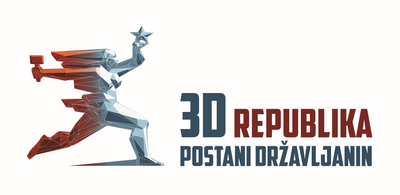
In that atmosphere, my friend Veljko Miletić - Mileta, with whom I often cycled, also appeared. Veljko is a graduate sculptor, and it was natural for me to discuss the logo with him. First we talked about the "nonsense" — the target group, the colors, the experience. We wanted something strong, black and yellow, but it reminded us too much of the dark motifs of the past.
And then Veljko did what only an artist can do. He didn't draw a logo — he guided us through the experience. The logo was not just a sign. It was a manifesto.
"3D Republic was never just about me. It was about people who believed they could create. About those who first picked up a hammer — digital or real — and said, 'Let's try.'"
The Story of 3D Republic: From Idea to Symbol
The winter of 2015/2016 wasn't just cold — it was a turning point. While the streets of Belgrade froze, something was boiling inside me: a decision to step into the unknown — the world of 3D printing. I was already a father to Lenka and Miloš, and that winter, I found out we were expecting our third child — Marko. Still, nothing could stop me. From the moment I saw 3D printing, I knew it was more than just technology. It was love. Because 3D printing brings things back from the digital into the analog world — from idea to tangible reality.
At that moment, I was surrounded by people without whom this story wouldn't even exist. One of them was Nenad Duduković — Duduk. A friend who loves me unconditionally — and I him. He played the role every crazy startup needs: the fool friend. The one who doesn't ask too many questions but always believes. The one who gives you money when you're stuck in a dead end — not because he knows you'll succeed, but because he knows you have to try. And that's priceless.
I also knew David Daković back then — a man whose guidance in business development helped me realize: I had to start 3D Republic. Because 3D printing isn't just a tool — it's a new way of manufacturing, the only one that allows for human-centered creation. And someone had to go out there and explain what that even means.
In February 2016, I got in my car and drove to Sofia. On the way back, in the trunk was my first Ultimaker 2+ Extended — but this wasn't just a drive. I crossed the Bulgarian border at a civilian checkpoint instead of a commercial one. That's how I ended up in a customs limbo — eight hours, no way out, no turning back. They assigned a man to watch over me until I reached the customs terminal in Belgrade. All because I wanted to do everything legally — but I didn't yet know how.
"As I sat for eight hours in that customs zone, I asked myself: 'Am I crazy?' Then I looked at the box and thought: 'If this works, it'll be worth every second.'"
At the time, I was still working at my father's print shop. The idea was to transform the business in light of new technologies, but the father-son dynamic is complex. My father had worked one way for too long, and changing habits was hard. There was no conflict, but there were obstacles. He was a symbol of tradition; I was trying to bring in the future.
The key moment came when my friend Filip Jovanović invited me to join him in his small office. He had just opened a digital dental lab and asked me to build something new with him. The office was tiny, but full of enthusiasm, support — and risk. We both took on big responsibilities, but together it was easier. Filip was a pillar of support and shared risk.
In that atmosphere, my friend Veljko Miletić — Mileta — also entered the picture. We often rode bikes together. Veljko is a sculptor by training, so it was natural to talk to him about the logo. At first, we talked about "nonsense" — target audience, colors, impressions. We wanted something bold, black and yellow, but it reminded us too much of dark symbols from the past.
Then Veljko did what only an artist can do. He didn't just draw a logo — he led us through an experience. The logo wasn't just a mark. It was a manifesto.
"3D Republic was never just about me. It was about people who believed they could create. About those who picked up a hammer — digital or real — and said: 'Let's give it a try.'"