

On the value scale of production by quantity, we can redefine the axes by which we judge the variability of the produced part. The three main axes would be:
- Quantity (Volume) – quantity of produced pieces
- Customization - customization of the product to the user
- Complexity – the complexity of the geometry of the part
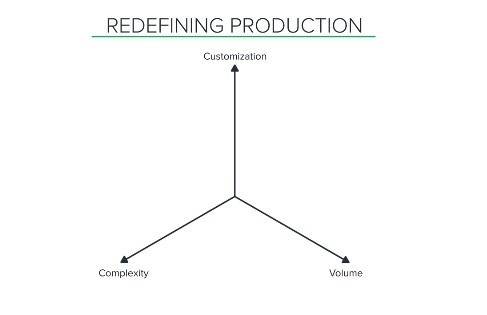
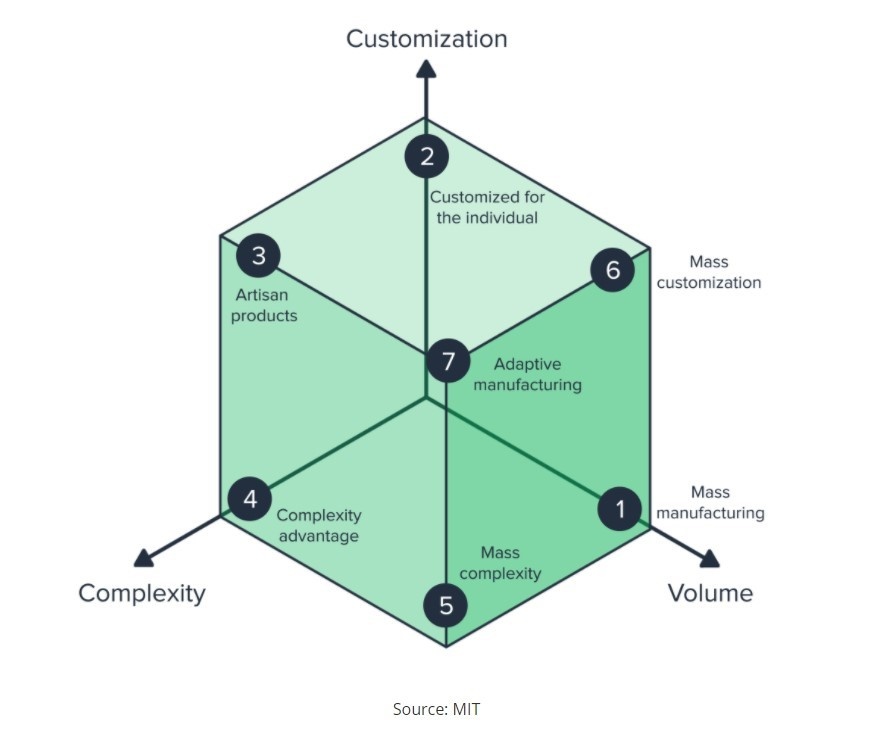
The entire space of production possibilities is divided according to three axes:
- Quantity refers to the amount of products (or parts) produced.
- Complexity refers to the level of complexity of a part or product. Complexity can relate to geometry (a structurally optimized carrier or mold with internal cooling passages), or function (eg an entire aircraft).
- Customization refers to how specific the product is to the needs of the end user.
Examples
- Mass Complexity
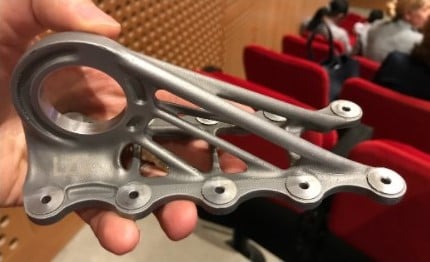
This is an optimized carrier for aerospace applications that reduces mass by removing excess material while maintaining sufficient mechanical strength and stiffness to fulfill its intended function. Assume that the carrier is produced in large quantities.
- Mass Customization
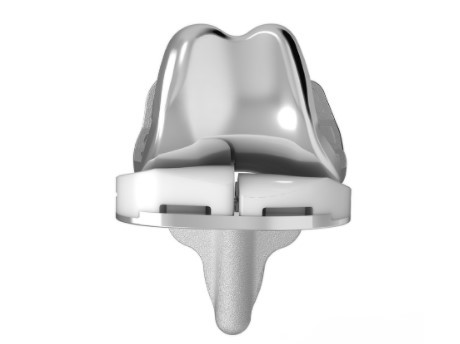
This is an implant for knee replacement surgery, which has its volumetric dimensions and curvatures adapted to the specific geometry of the patient's joint. The total quantity produced of this implant is large, but since one part of it is adapted to a specific patient, it is produced by AM, after which it is polished and coated.
- Adaptive Manufacturing

This is an orthodontic prosthesis used to correct errors in the patient's bite. The brace (foil) is made using 3D printing and features an extremely detailed, curved shape based on a 3D scan of the patient's teeth. The prosthesis is shipped to many customers worldwide.
- Mass Complexity
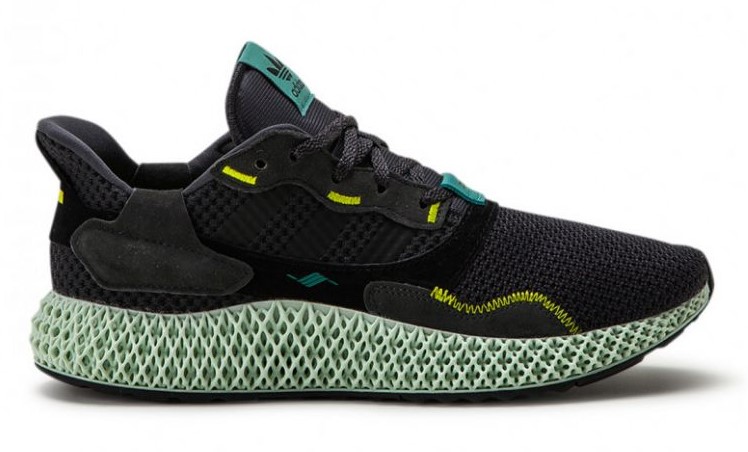
This is a running shoe, the Futurecraft 4D, made by Adidas. The sneaker has a 3D printed midsole with spatially profiled grid geometry. This allows better performance of the shoe at different points of contact with the ground. The heel area has a more open structure designed to absorb impact, while the front surface has a stiffer grid to conserve kinetic energy and maintain forward momentum. The sneaker is produced in large quantities with a fixed geometry, in standard sizes.