
Advantages of additive manufacturing
- Enables complex geometry
- Production of parts without the need for making special tools - "specialized tooling"
The relationship between price and complexity in additive manufacturing
- The cost of producing a complex model using additive manufacturing can be lower than the production of a simple model because the production of a complex part requires less time and less material.
The price of the product in relation to the quantity
The definition can be applied to the most basic things like food and water, complex electronics and advanced systems like cars and airplanes that contain thousands of parts, mechanical and electronic.
In order for these products to reach the market, to improve the quality of our life, but also to bring profit to the manufacturer, we need to produce in large quantities due to investment in tools and machines, design and business expansion, which is necessary for the manufacturer to take a position in the market.
Precisely because 3D printing is not limited by traditional methods of shaping and processing, it offers great potential for savings.
In the production of aluminum ingots, a large amount of energy is spent on extracting bauxite and making aluminum. And then that raw material needs to be processed by rolling, and only then is it cut into parts. And these are all steps that precede traditional processing methods.
Manufacturing from an additive manufacturing perspective can greatly shorten that process. And that's why it's different. Additive manufacturing has a flat cost per part, as opposed to the curve of mass production.
In other words, the price per part is the same, regardless of whether you produce a few pieces or several thousand pieces. That's not entirely true, but let's say it is for now.
For years now, the balance point of production costs using traditional methods and 3D printing has been shifting, progressing towards higher volumes. And we can always compare the cost of producing a part using traditional methods and additive manufacturing. But we can also use the advantages that AM gives us, such as freedom in design. And this is best seen on the example of this aircraft engine mount.
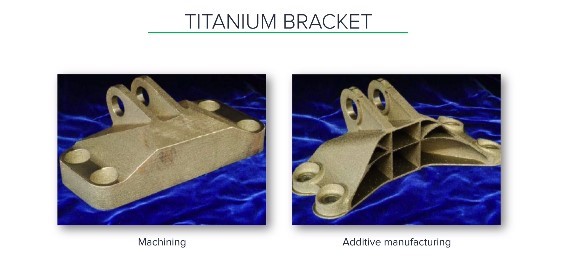
General Electric set it as a challenge a few years ago and solutions have come from all over the world. The challenge was to come up with a new design, to make the part lighter and therefore to save on material. The picture shows the winning solution.
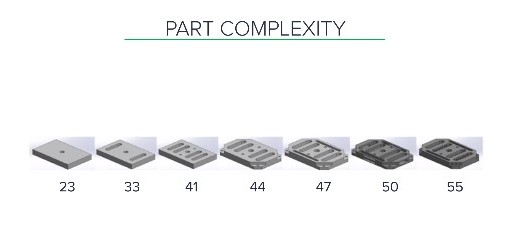
In the model shown below, the complexity increases while it retains the outer volume or bounding box. And if we ask the tool shop to produce one copy of everyone from the picture, we will see how the price increases with the complexity of the model. Obviously, because more detail requires more processing on more expensive and longer-running machines.
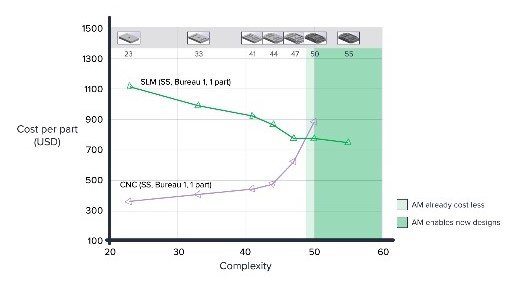
If we compare that price with the production price of the same part, i.e. parts, with 3D printing technology, for example SLM, we will notice that the price decreases with the complexity of a part. A more complex part requires less material and less time.
However, if we compare the surface quality of the part obtained by traditional production and 3D printing, we will see that the printed part still needs finishing. Regardless, the complexity you can achieve with additive manufacturing is not comparable to that achieved with traditional methods. Also, a 3D printed part is solid on the outside, but can have a lattice structure on the inside. This reduces the amount of material and production costs, and the performance of a part can be improved.
The table below shows that we have already reached the moment when the production of one model with complex geometry is cheaper than the traditional way of production.
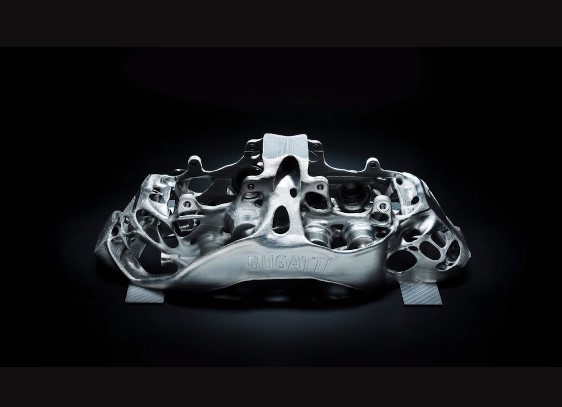
The brake caliper (shoes) made for the latest Bugatti is an excellent example of a part that has complex geometry and is in fact simple for additive manufacturing. It is a production part whose function is to improve brake performance while reducing weight.