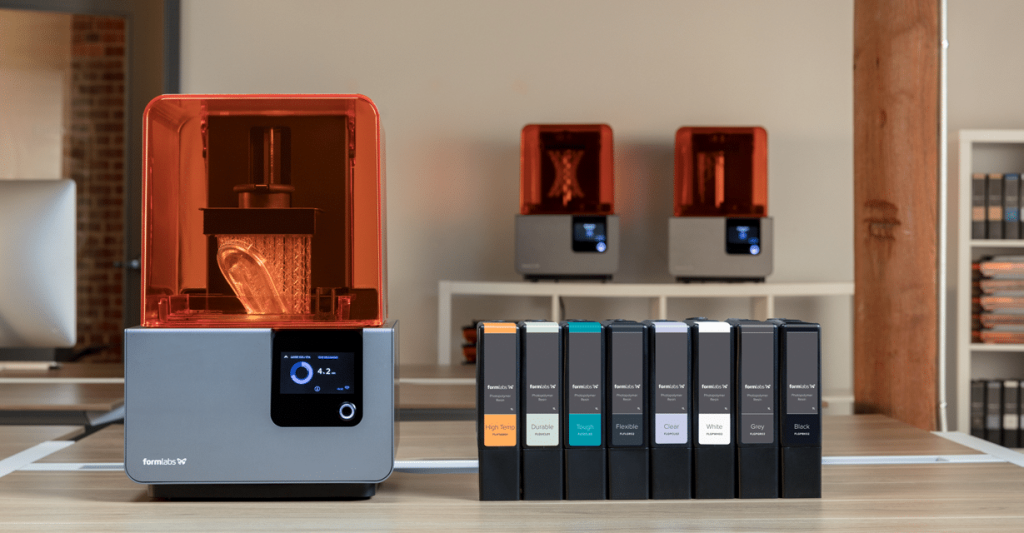

The company Coalesce from Great Britain develops products for the application of drugs in the pharmaceutical industry with the help of 3D printers.
The challenge for the company was the design of the inhalation pump, which had to have a small tolerance when assembling the parts. Using traditional methods, the development of this product required a very long production time. Coalesce overcame this hurdle by using a stereolithography (SLA) 3D printer, achieving a prototype for testing and demonstration, complete with painting, in just a few days.
The result of their changes in the production process is:
- Reduction of prototype production time by 80-90%, from 1 to 2 weeks to only 1 to 2 days.
- Cost reduction by 96%, from £250 to £11.
- Prototypes produced by 3D printing were used in a clinical study, and the presentation was thought to be the finished product.
The perfect balance between design and functionality
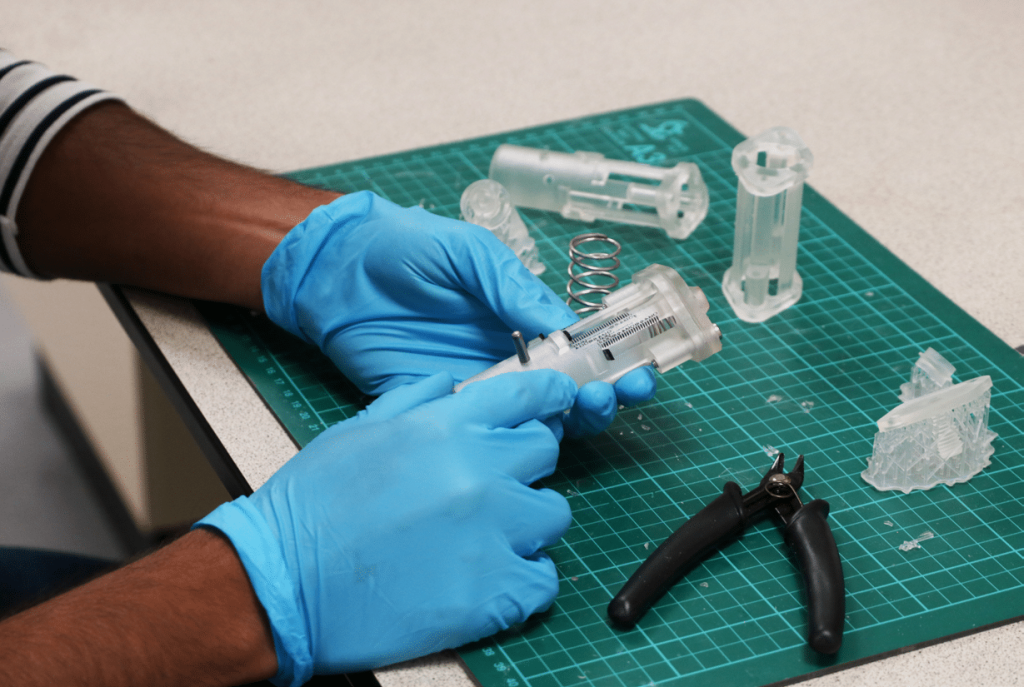
Medical devices often have complex geometries that are often very demanding for prototyping using traditional manufacturing methods. Coalesce had the challenge of a device that had to conform to the human anatomy, and because of this they had to strike the perfect balance between size, weight and shape while the device itself could not lose its functionality for testing and further iterations.
Coalesce had to produce a prototype that would serve for human evaluation factors and technical assessment of mechanisms. To evaluate the product, the company has developed and your rigs, templates and guides.
In-house 3D printing enabled Coalesce industrial engineer Vinnay Chhabildas to take complex and custom CAD shapes and turn them into a physical prototype within days instead of weeks.
Challenge
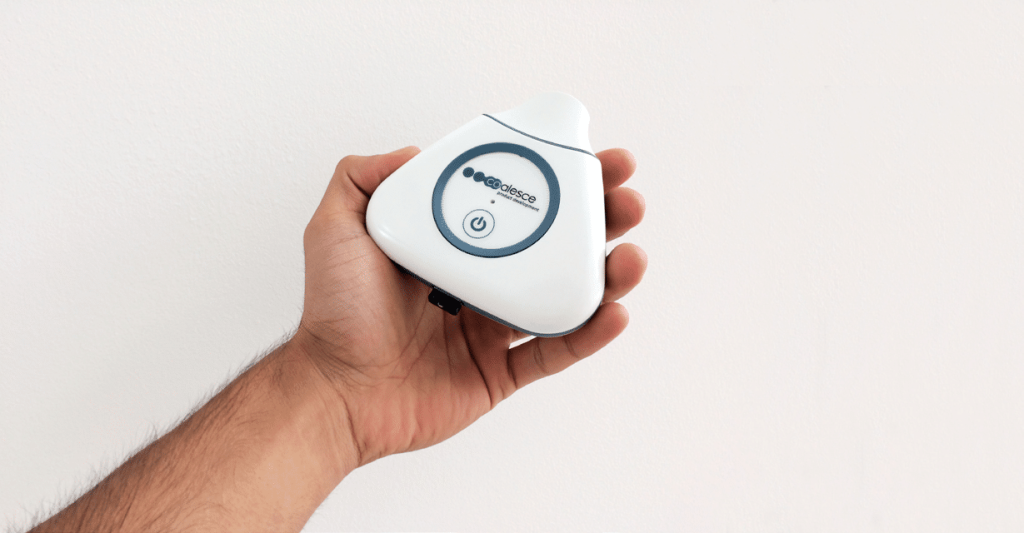
The Coalesca Breath Profiling Device (BPD) is designed to digitally profile breathing in patients with asthma. A spirometry machine, used by clinicians to measure a patient's lung function, is often expensive or bulky, or portable but low-tech. The BDP device is an inexpensive and portable alternative to spirometer devices.
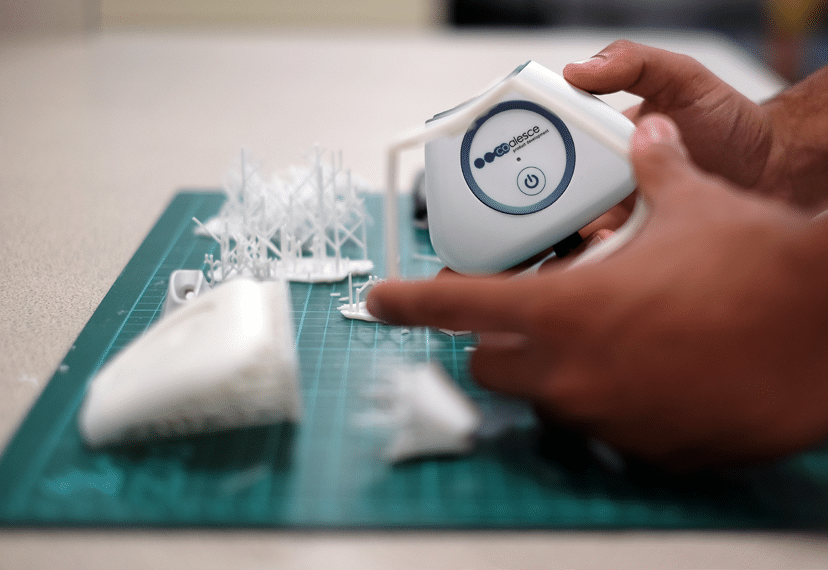
Chabidal had a request that the surface of the device prototype be smooth, that the device be robust, durable and able to carry holders and guides for internal PCB electronics.
For many years, the company has serviced SLA 3D printing. After experimenting with other 3D printing technologies such as FDM (Fused Deposition Modeling), they concluded that SLA technology is unassailable in terms of the quality of the final layer.
“Before we invested in Form 2 printers, we relied entirely on service prototyping. Instead of doing multiple iterations in a day, as we can with Form 2, these cycles were longer and we had less control in finishing critical parts of the geometry.”
The solution
Coalesce used an in-house 2 Form 2 3D printer to develop and prototype the critical geometry for the BPD device case. The designers chose white resin for the material because of its smooth finish and mechanical properties, which allowed them to drill and insert brass inserts.
“Stereolithography offers a good balance between resolution, finish, durability, material selection and dimensional stability. Because we develop devices with moving parts, we needed an effective way to prototyp the small mechanisms inside the device case. We've been following the progress of 3D printing technology for the past few years, and we liked the approach of Formlabs . When the Form 2 came out we ordered one immediately and then another just a few weeks later."
Results
Initially, 3D printed prototypes were used to develop the product architecture. Once the design was stable, the printed parts were painted and taken to the Drug Delivery to the Lungs conference.
The prototypes looked so realistic that they were mistaken for the finished product. Finally, those same prototypes were used for a clinical study. Participants were asked to inhale through the device as they felt they should. The results showed how much variation can occur between different untrained breath profiles.
Using service 3D printing, costs would be up to 20 times higher than In-House 3D printing itself. Prototyping the BPD device cost £11 on Form 2 as opposed to the £250 it would cost for a service press. According to Chabildas, however, the real benefit is the time savings: the parts were printed in only 8 hours and could be processed and painted in just a couple of days. The same process with a subcontractor would take a week to two.
| BPD case study | In-House 3D printing | Utility 3D printing |
| Costs | £11 | £250 |
| Build time | 1-2 days | 1-2 weeks |
Both of our Form 2 devices are constantly working. We learned how to get the best results from the 3D printer and materials, and how to do the finishing so that the parts look the closest to the finished products. Now we can design objects with switches or even add threaded inserts so that parts can be screwed together.