

For the comparison of 3D printing, we took DMLS and BDM metal printing technologies as characteristic representatives, and FFF (FDM) technology as a distinctly different side of 3D printing from the two listed.
Every 3D printing technology, like CNC, has its advantages and disadvantages. Due to this fact, each of them is suitable for different application in production. First, let's look at the benefits and challenges of each of the technologies.
DMLS 3D METAL PRINTING TECHNOLOGY :
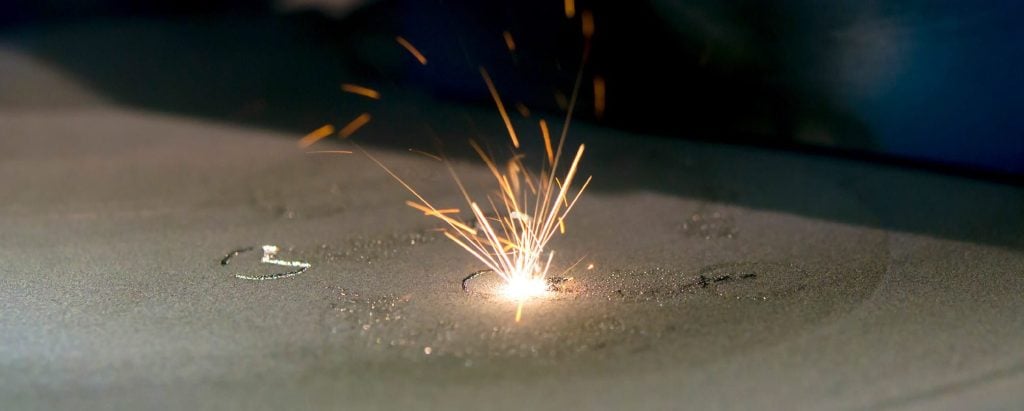
| Advantages | Challenges |
| • Geometric complexity does not create additional costs. | • Metal powder is flammable and requires an oxygen-free press chamber. |
| • Allows the production of solid and light parts. | • Higher costs per unit than in traditional production |
| • High reproducibility and consistency in results | • Finishing can be up to 50% of the total production time. This includes tempering, bench cutting, removal of unsintered powder, surface treatment. |
| • Can achieve the highest density possible in metal 3D printing | • Slow printing |
| • Features more process simulations and reports than other technologies | • Some corners in the model geometry must be avoided to avoid collisions with the powder application arm. |
| • Printing of fully enclosed hollow parts is difficult due to ejection of unsintered powder. | |
| • High cost for repeating a failed print. | |
| • Parts are welded to the workbench due to residual stress. | |
| • Material replacement requires decontamination with a wet vacuum separator. | |
| • It is recommended to use one machine per alloy group. |
BDM 3D METAL PRINTING TECHNOLOGY:
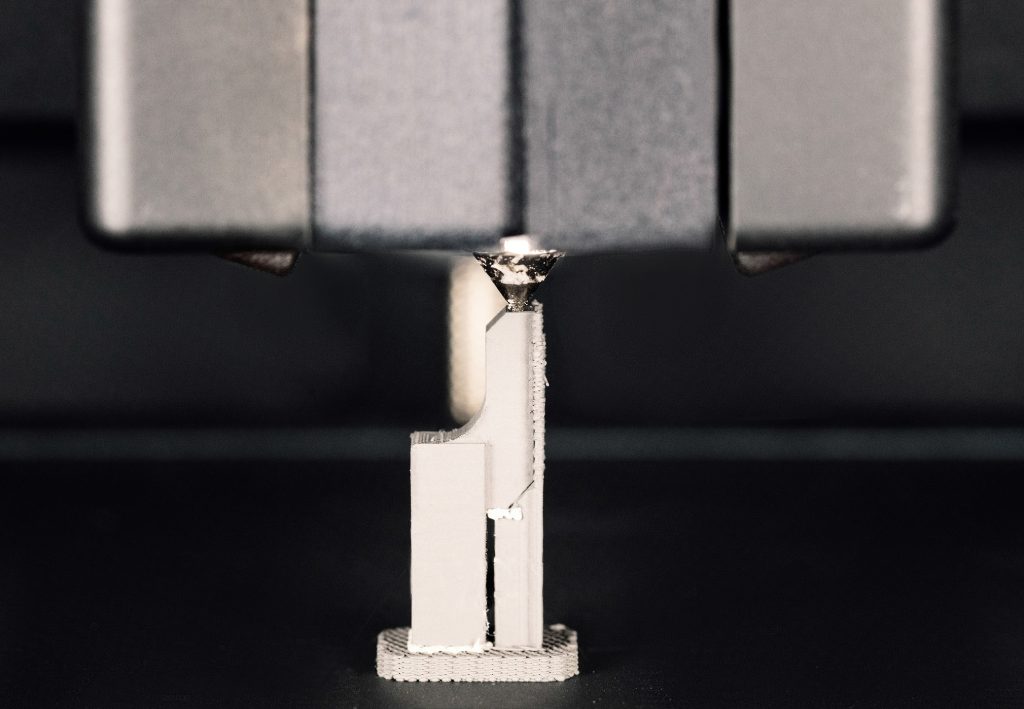
| Advantages | Challenges |
| • Geometric complexity does not create additional costs. | • Lower strength and density than with DMLS technology. |
| • There is no safety hazard due to flammable material. | • Requires additional finishing such as washing, drying, sintering, surface treatment. |
| • Faster than DMLS. | • Parts shrink about 20% during sintering and software optimization of model size is required. |
| • Easier processing before sintering the "green" part. | • "Green" parts are easily breakable. (Same density as Creon) |
| • No residual stress on the printed or sintered part. | |
| • Grateful for working in the office. |
FDM (FFF) 3D PRINTING TECHNOLOGY:
| Advantages | Challenges |
| • Geometric complexity does not create additional costs. | • Most thermoplastic materials have greater limitations than metals. |
| • There is no safety hazard due to flammable material. | • Some parts require additional hand finishing. |
| • Scalable due to affordable hardware. | • The orientation of the model for 3D printing is important due to the anisotropic mechanical properties within the layers. |
| • Easy to use. | • The software does not have the same manufacturing simulations as DMLS systems. |
| • Does not require hazardous chemicals. | |
| • Great freedom in the design of high geometric complexity due to the use of water-soluble support material. | |
| • The system uses all materials that can also be used in plastic injection molding. | |
| • Grateful for working in the office. |
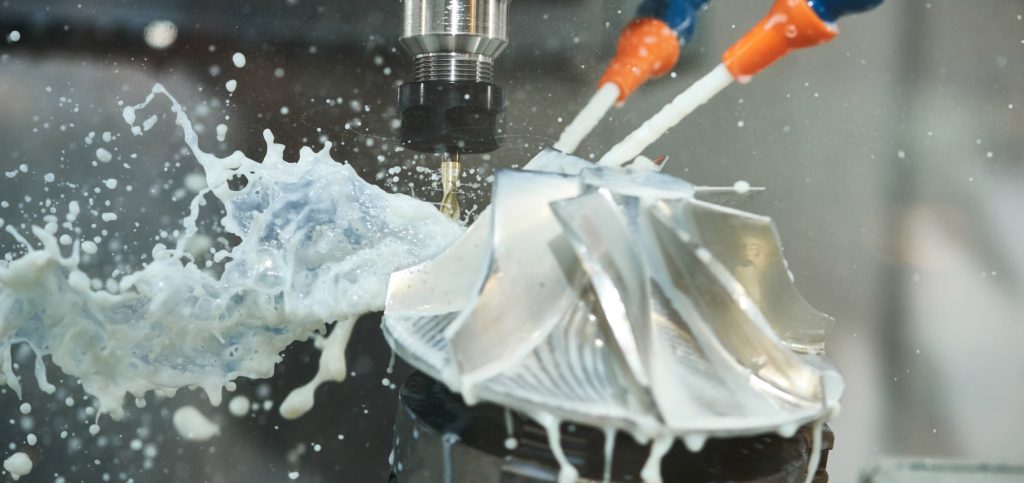
| Advantages | Challenges |
| • Larger processing surface than working volume as in additive manufacturing. | • Parts of complex geometry require longer manufacturing time and higher production costs. |
| • Excellent tolerance (up to ±0.025mm) | • Waste material is created. |
| • The isotropic physical properties of the base material for production are maintained. | • Some internal geometries cannot be created. |
| • Most materials can be processed with the help of CNC technology. | • Parts cannot be lightened using reduced padding. |
| • Fast manufacturing when it comes to parts whose geometry is optimized for manufacturing technology by removing material. | • Noisy and dirty compared to 3D printing. |
| • Geometric features are limited to specific tool geometries. |
Comparative view of 3D printing technologies with metal, plastic and CNC processing:
| DMLS/SLM | BMD | FFF (FDM) | CNC | |
| Useful working volume | 250x250x325mm | 254 x 170 x 170 mm | 330x 240x 300 mm | 2,000x 800x 100mm |
| Characteristic speed of production | 2.0 mm 3 /s Depending on speed of powder application. | Up to 4.4 mm 3 /s | Up to 24 mm 3 /s | Too much variables to determine the exact speed (Behavior of materials during processing, tool speed, continuity in cutting and programming |
| Materials | Various including steel, aluminum, titanium Ti64, inconel, bronze, copper, precious metals | Stainless steel 17-4 PH (other types of stainless steel, titanium and inconel are in development as MIMports for alloys). | Various engineering polymers, including glass and carbon fiber reinforced materials and materials with metal particles. | Almost everyone engineering materials processed from the basic block. |
| System type according to the material | Closed system | Closed system | Open system | - |
| Accessories / objects | A special place in drive, ventilation in the inert gas supply system (nitrogen or argon), oxygen sensor, HAZMAT for disposal of unused powder, "wet" vacuum, dry powder fire extinguisher (Class D), personal protective clothing (including respirator), fireproof storage cabinet. | A special place in drive, optional external or internal gas connection for the stove for sintering. | Optional ventilation | A special place in drive, storeroom for raw materials, coolant supply, place for disposal of flammable waste oil, protective gloves, waste bucket, refractometer for measuring cooling solution. |
| Training | Five days in three operator, learning only one material. | One day training. | Recommended: 30 minutes to 3 hours. | Two days in two operator. |
| Application | High quality functional prototypes, small series of consumable parts, spare parts parts. | Functional prototypes, small series of consumable parts, custom products, spare parts parts. | Quickly prototyping, functional prototypes, small series of usable parts, spare parts, cores for metal casting molds. | Functional prototypes, small to medium series of consumable parts, custom products, spare parts of simple geometries. |
Comparison of time spent working with DMLS, BMD and FDM 3D printing technologies:

What are the possibilities for plastic to replace metal?
Taking into account the cost of production of metal parts with 3D printers or CNC machines, opportunities for application are opening up plastic parts - produced within the company or as a service - instead metal. This is a reality as 3D printing technology has become more affordable and materials have advanced dramatically. More and more we see this kind of change in apply to our clients, where the plastic part offers a cheaper, lighter and a more ergonomic alternative to metal.
Below you can look at 4 key properties of the material where plastic parts are made on A 3D printer can replace a part that would normally be made of metal.
Recommendation is to use filaments made from advanced polymers produced by leading manufacturers company. Each material has a pre-configured profile that can be download from the Ultimaker Marketplace page, which takes the guesswork out of it when working with these filaments on Ultimaker 3D printers.
Heat resistance
Doc usually 3D printed metal parts such as stainless steel and aluminum withstand temperatures up to 400˚C, they also conduct heat, which makes them makes it unsuitable for many applications. The following polymers in filament have good heat resistance performance:
DSM Arnitel ID 2060 HT is the first high temperature thermoplastic copolyester on the market. It has a good resistance of 1000 hours at 175˚C, and 500 hours at 190˚C. Applications include air-fuel management systems, engine guards, covers, gaskets and seals in the automotive industry. Because of this high performance, the material can also provide a replacement for aluminum or rubber for easier under-the-hood applications.
Clariant PA6/66 GF 20 FR is a semi-crystalline thermoplastic filament reinforced with glass fiber. This material achieves UL 94 V-0 flammability standard and excellent abrasion resistance. In combination with Exolit® fireproof material, it will extinguish the flame in less than 10 seconds and will not stay burning. It also has reduced thermo-oxidative degradation, which means that its polymer bonds lose their mechanical properties more slowly when the material is exposed to heat. These properties make it suitable for functional utility parts and prototypes.
Chemical and corrosion resistance
Stainless steel 17-4 PH is known for its corrosion resistance. But depending on what chemicals your part will be exposed to, some thermoplastic materials have built-in exceptional resistance to chemical reagents.
Arkema FluorX by Kynar® PVDF (polyvinylidene fluoride) is chemically resistant to automotive fluids (fuel, oil and lubricants), fully halogenated hydrocarbons, alcohols, acids and bases. It also has thermal resistance that reaches constant temperatures of 150˚C.
DuPont Zytel® 3D12G30FL BK309 is a specialized nylon that has the power to resist solvents, cleaning chemicals, automotive fluids and fuels at room temperatures. Reinforced with 30% glass fibers, it exhibits similar mechanical and chemical properties to known plastic injection molding materials.
Abrasion resistance
For applications where a low coefficient of friction is a priority, polymers have better performance than metal. Metal-to-metal contact requires lubricants to effectively reduce friction and wear and tear. However, for applications that must function "dry" or in conditions low lubrication, self-lubricating polymers can increase component life and reduce the frequency of maintenance. Those applications include plain bearings, toothed wheels, gears, piston rings and gaskets.
Igus Iglidur l180-PF is a self-lubricating filament that is up to 50 times more durable than other polymers. This means that it is suitable for applications that require low friction and high abrasion resistance. Examples of such parts are non-lubricated bearings, moving assemblies and complex wear parts, templates and guides.
Strength and toughness
If tensile strength is a critical property for parts bearing load, your first choice would be stainless steel or tool steel steel - regardless of whether it is machined on a CNC machine or fabricated on metal 3D printer. However, thanks to polymers reinforced with glass or carbon fibers, plastic parts made on a 3D printer can offer an easier and a cheaper alternative with good strength and toughness.
XSTRAND™ GF30-PA6 comes to us from Owens Corning. It is an FDM (FFF) compatible material reinforced with 30% fiberglass. It is an exceptional general purpose material that has high tensile and flexural strength when bending, functions over a wide range of temperatures (-20˚C to 120˚C), and good chemical and UV resistance.
DSM Novamid® ID1030 CF10 is a polyamide reinforced with 10% carbon fibers. It can be used for 3D printing of durable parts with good mechanical properties, approximately the same as those achieved during injection molding. It is suitable for use in the production of various under-hood brackets, structural guides and templates, and high-performance structural parts.
3D metal printing with FDM (FFF) technology
Ultrafuse 316LX from BASF is a metal-polymer filament that offers an easy entry into the sphere of metal 3D printing with a low investment. It is compatible with 3D printers with an open filament system, it is a filament metal-polymer composite of austenite type stainless steel 316L in the form of powder. Designed to existing MIM industry catalytic separation standards plastic binder of metal particles and sintering, this material gives high quality metal parts. Possible applications include the production of special tools, guides, templates, functional components and consumable parts in small series.
Conclusion: Metal vs. Plastic 3D printing
Despite the high price, metal 3D printing has significant advantages. However, those advantages make financial sense for small number of applications in the industry favoring product innovation and performance while achieving a certified quality standard. For DMLS, these applications include weight reduction, fewer assembly parts and topological optimization for evio i auto industry.
BMD is more affordable but less developed technology. A low purchase price still carries a high cost per manufactured part due to the extra step in the process of removing the binding material (Debinding) i sintering. The announced portfolio of materials for BMD should increase cost effectiveness of technology. This portfolio is still waiting, and besides this will continue to be an expensive system with closed materials.
Polymer 3D printers that have an open the material system offers in-house the most cost-effective solutions. For reasons as these systems support rapid iterations and validations, they build on print metal through outsourcing the final design. If mechanical stress on your part requires a 3D printed metal part, service fabrication remains the most affordable for small volume of production.
Ultimaker S5 together with Ultimaker Material Alliance program, opens the possibility to print with more than 80 world brands such as BASF, DSM and DuPont. This unique collaboration makes it possible to this reliable and affordable 3D printer provides a turnkey work process hands" with increasingly sophisticated materials.
Make the most of your budget
The biggest mistake you can make is to assume that metal functional parts that you previously serviced you need to automatically produce metal with a 3D printer.
With reliable and easy-to-use 3D printer that works with plastic materials, your investment in in-house production capacity can be of greater use by using it more frequently and reaching a return quickly on investment.